Bermudez, J., Chang, L.-C., Koubeissi, M. Z., Beaudoin, T., Trudeau, E., Ebadi, A., Djebbara, Z., Moore, M., Keagle, J., & Nakamura, Y. (2026). Cognitive-aesthetic effects of sacred vs. secular architecture on believers: A neurophenomenological exploratory study. Brain and Environment, 8, 100023. https://doi.org/10.1016/j.braen.2026.100023
Find the full paper here.
Sacred architecture has historically served to communicate religious teachings and elicit spiritual experiences. Although theologians and architects have offered explanations for this phenomenon, empirical evidence supporting these claims remains scarce. Scientific research on religious responses has usually overlooked architecture’s role in shaping them.
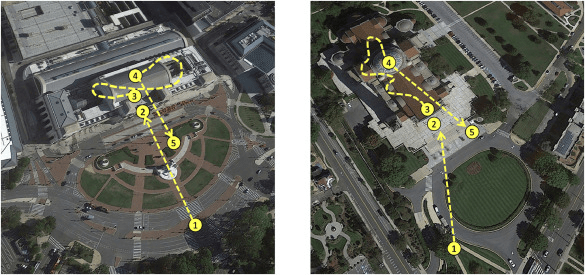
This study utilizes mobile electroencephalography (EEG), physiological sensors, and self-report questionnaires to measure neural, autonomic, behavioral, and psychological responses in 32 Catholic participants exposed to religious and secular architectures: a Catholic church and a train station. Compared to the secular building, the church significantly reduced anxiety and everyday thinking while increasing perceived beauty and a sense of spiritual reality. Participants also reported feeling more connected to others and the world, and a stronger sense of faith.
Machine learning of EEG data identified Gamma frequency, followed by Delta and Beta, as key markers distinguishing sacred from secular settings in intra-subject classification during five stops of the visit. Microstate analysis of EEG data from the entire session showed reduced temporal activation of the Default Mode Network in the church. EEG frequency analysis highlighted significantly greater parietal activation in the sacred space. Physiological and behavioral responses in the church included slower movement, lower blood pressure, higher heart rate, and decreased body temperature — effects not observed in the secular setting.
These findings suggest that sacred architecture triggers distinct neuro-physio-phenomenological responses in Catholic believers linked to religious experience. Utilizing empirical methods to evaluate the effects of architecture and belief, this study lays the groundwork for an emerging field: experimental theological aesthetics.