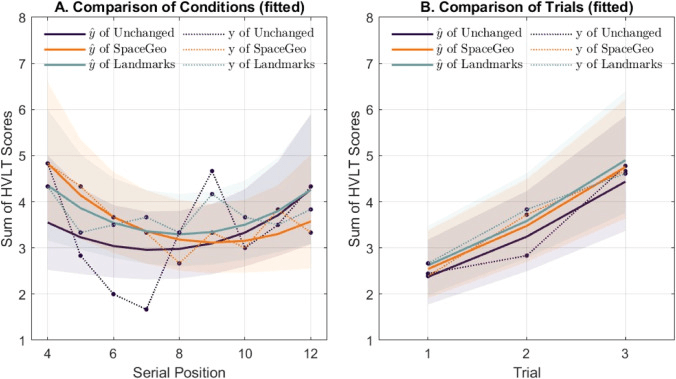
The built environment profoundly influences our brain, shaping how we perceive, remember, and interact with the world around us. Far from serving solely aesthetic or functional purposes, specific elements and characteristics of cities can have an impact of specific cognitive processes. For instance, landmarks in urban settings play a pivotal role in guiding navigational decision making and behavior, helping us to orientate ourselves, and move through complex spaces by remembering different details of the environment. Despite this understanding, the ways in which diverse environmental features affect memory remain largely unexplored. This study investigates the impact of landmarks on memory performance within a virtual urban environment. Using the Hopkins Verbal Learning Test, a measure of verbal episodic memory, in combination with immersive head-mounted Virtual Reality, participants (n = 35) navigated a virtual cityscape designed with distinct environmental variations. The conditions include landmarks, space geometry, and an unchanged condition. Results reveal that participants exposed to Landmarks and Space Geometry demonstrated enhanced episodic memory performance compared to those navigating through the unchanged condition. Specifically, participants exhibited a faster learning rate between trials and improved memory retention in environments featuring landmarks and space geometry. These findings highlight the impacts of environmental distinctiveness and suggest that both landmarks and space geometry serve as effective mnemonic components in episodic memory tasks.
Kalantarifard, A., Faizi, M., Ekhlassi, A., Behzadi, F., & Djebbara, Z. (2025). Color and Pattern of Material Reflect Thermal Perception in Early Brain Dynamics (SSRN Scholarly Paper No. 5332545). Social Science Research Network.
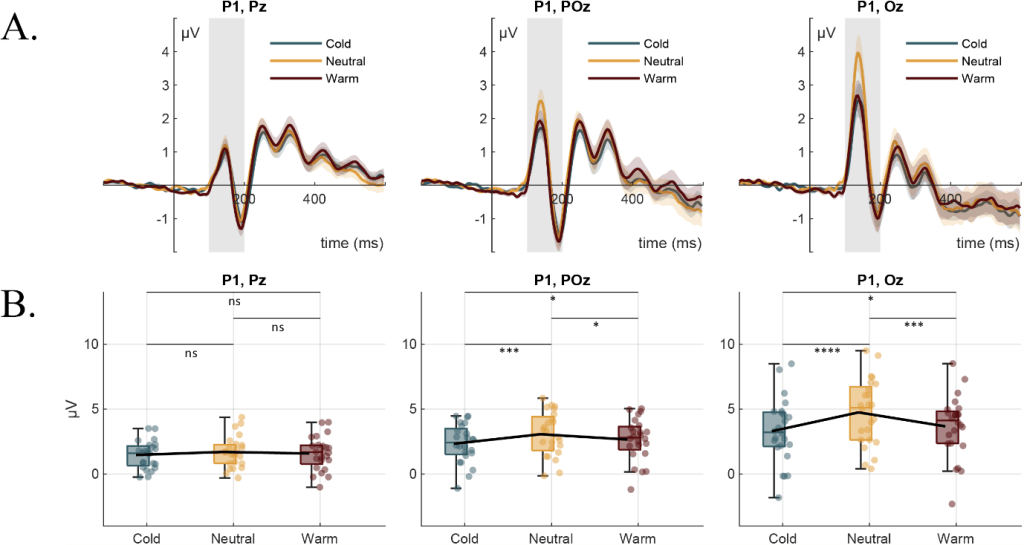
Thermal perception within indoor environments is shaped by the integration of multiple sensory inputs, with visual stimuli playing a critical role. While existing work has demonstrated that room color can influence thermal perception under directed attention, it remains unknown how this effect manifests when the colored environment is perceived passively during an ongoing cognitive task. In this study, we investigated the combined effect of wooden materials’ visual characteristics—namely, color and pattern—on evoked brain responses. A combination of three wooden colors (Warm, Neutral, and Cold) and three pattern complexities (No-, Simple-, and Complex-Pattern) formed nine different Virtual Reality (VR) environments. Subjective thermal evaluations and ongoing neural responses were recorded via electroencephalography (EEG) during an Oddball paradigm task (N = 24). Subjective reports demonstrate that wood colors and patterns significantly affected thermal perception. We extracted the P1 and P2 components over the parieto-occipital area and analyzed them using a mixed linear effects regression, demonstrating the impact of wood color on P1 and pattern complexity on P2. Our study indicates that early attentional processes are significantly influenced by color, with warmer hues leading to an increase in perceived temperature. Although the effect of pattern on thermal perception appears to be relatively minor, denser visual patterns were still associated with a further rise in perceived warmth. Future research could compare the visual impact of various materials on thermal perception.
Zair, N., Boussora, K., & Djebbara, Z. (2025). Contemplative neuroaesthetics in architecture: A real-world mobile EEG study in the ancient city of Ghardaïa, Algeria. Frontiers of Architectural Research, 14(5), 1311–1327.
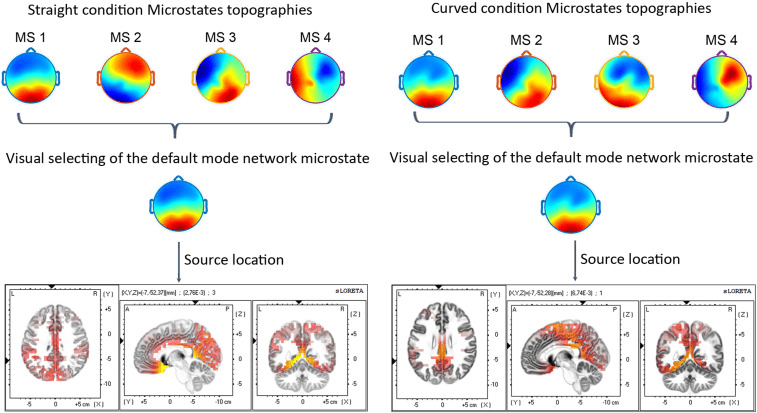
This study investigates the potential of built environments to induce contemplative states, contributing to the emerging field of contemplative neuroaesthetics. While the psychological benefits of these states are well-documented, their relationship with architecture remains underexplored. Using an embodied cognition framework, we explore how architectural features engage the sensorimotor system, fostering contemplative experiences. The ancient city of Ghardaïa, known for its natural harmony and subtle aesthetics, was the case study. Twenty participants, with no prior exposure to the site or architectural background, took part in a real-world experiment. They followed a designated path while equipped with a 32-channel mobile EEG system, smart band, and wide-angle cameras. Subjective feedback was collected via questionnaires. Multiple linear regression revealed that curved pathways significantly reduced Default Mode Network (DMN) activity, suggesting heightened sensorimotor engagement, potentially inducing a contemplative state. Conversely, higher occlusivity, measured through space syntax, correlated with increased DMN activity, indicating enclosed spaces promote introspection. Architectural features like corbels, arches, and landmarks also influenced DMN activity, highlighting spatial elements’ role in shaping brain dynamics. Future research should examine architectural contexts to clarify these mechanisms, with implications for designing spaces that promote well-being.
Canepa, E., Djebbara, Z., Güler, K., Andrighetto, L., Schiavetti, I., Scelsi, V., Jelić, A., & Condia, B. (2025). Architectural atmospheres, priming effects and first impressions: A multi-perspective approach integrating self-report assessments and physiological responses. Architectural Science Review, 68(5), 379–391.
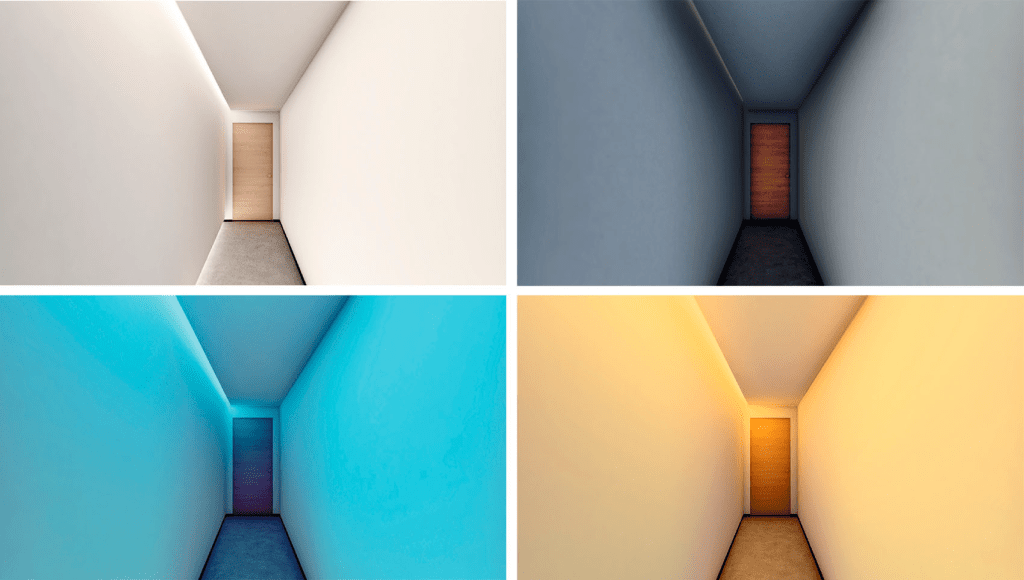
This paper studies the priming effects of architectural atmospheres on our first impressions of space. We applied a multi-perspective approach combining first-person-perspective insights (self-report assessments) with third-person-perspective measures (physiological responses) to four corridor iterations connecting an empty room to a contemplative space. The starting and ending rooms remained unchanged, whereas the corridor’s light varied: dark, blue, amber and bright. Participants (n = 81) walked through virtual-reality environments wearing sensors collecting blood volume pulse and skin conductance data. Our investigation was whether and, if so, how the corridor’s atmosphere primed and altered participants’ impressions of the subsequent room, even if identical. Results revealed stronger skin conductance responses while moving through darker corridors, which correlated with altered perceptions of the ending room at conscious and nonconscious levels. Generalized linear model analysis showed that, with increasing age, participants were more likely to report altered perceptions.
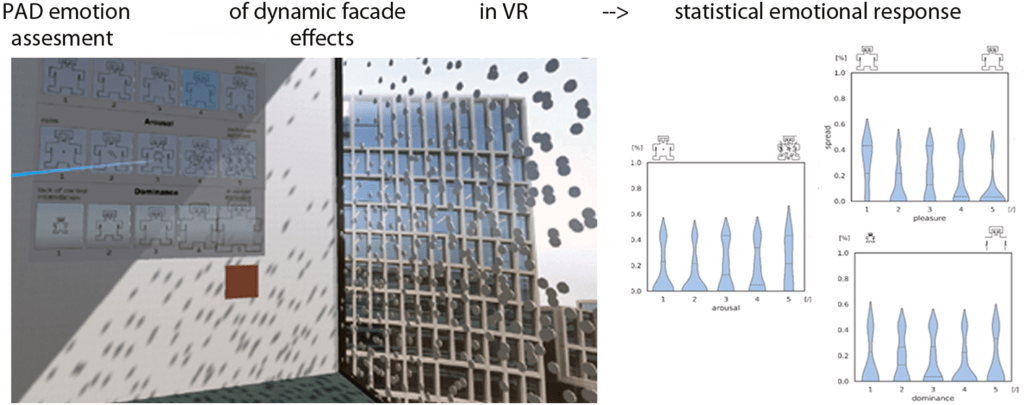
Buildings are increasingly required to have a restorative effect as people spend a significant portion of their time indoors, inducing them stress. In this regard, the research investigates the emotional impact of adaptive façades, focusing on the correlation between shadow patterns and emotions elicited. Using a combination of controlled Virtual Reality experiments and statistical comparisons, the study explores how different dynamic effects, abstracted from the specificity of the design, influence emotional responses, the latter based on the PAD (Pleasure-Arousal-Dominance) affection model. Empirical data supports the hypothesis that dynamic architecture can significantly enhance the emotional experience of indoor environments, highlighting the potential for adaptive façade designs to enhance indoor environments. Future studies are recommended to validate these findings in real-world settings and explore the integration of additional sensory dynamics, also considering demographic factors. This study marks a first step in exploring the possibility to inform design practices by linking abstract design features and emotional impacts.
Wang, S., Djebbara, Z., Sanches de Oliveira, G., & Gramann, K. (2024). Human brain dynamics dissociate early perceptual and late motor-related stages of affordance processing. European Journal of Neuroscience, 60(4), 4639–4660. https://doi.org/10.1111/ejn.16461
Affordances, the opportunities for action offered by the environment to an agent, are vital for meaningful behaviour and exist in every interaction with the environment. There is an ongoing debate in the field about whether the perception of affordances is an automated process. Some studies suggest that affordance perception is an automated process that is independent from the visual context and bodily interaction with the environment, whereas others argue that it is modulated by the visual and motor context in which affordances are perceived. The present paper aims to resolve this debate by examining affordance automaticity from the perspective of sensorimotor time windows. To investigate the impact of different forms of bodily interactions with an environment, that is, the movement context (physical vs. joystick movement), we replicated a previous study on affordance perception in which participants actively moved through differently wide doors in an immersive 3D virtual environment. In the present study, we displayed the same environment on a 2D screen with participants moving through doors of different widths using the keys on a standard keyboard. We compared components of the event-related potential (ERP) from the continuously recorded electroencephalogram (EEG) that were previously reported to be related to affordance perception of architectural transitions (passable and impassable doors). Comparing early sensory and later motor-related ERPs, our study replicated ERPs reflecting early affordance perception but found differences in later motor-related components. These results indicate a shift from automated perception of affordances during early sensorimotor time windows to movement context dependence of affordance perception at later stages, suggesting that affordance perception is a dynamic and flexible process that changes over sensorimotor stages.
Nielsen, M. B., Lomholt, C., Yaloz, T., Busk, C. M., Dammann, M., & Djebbara, Z. (2024). Does the visibility of destination matter for navigation?https://doi.org/10.1080/00038628.2025.2476648
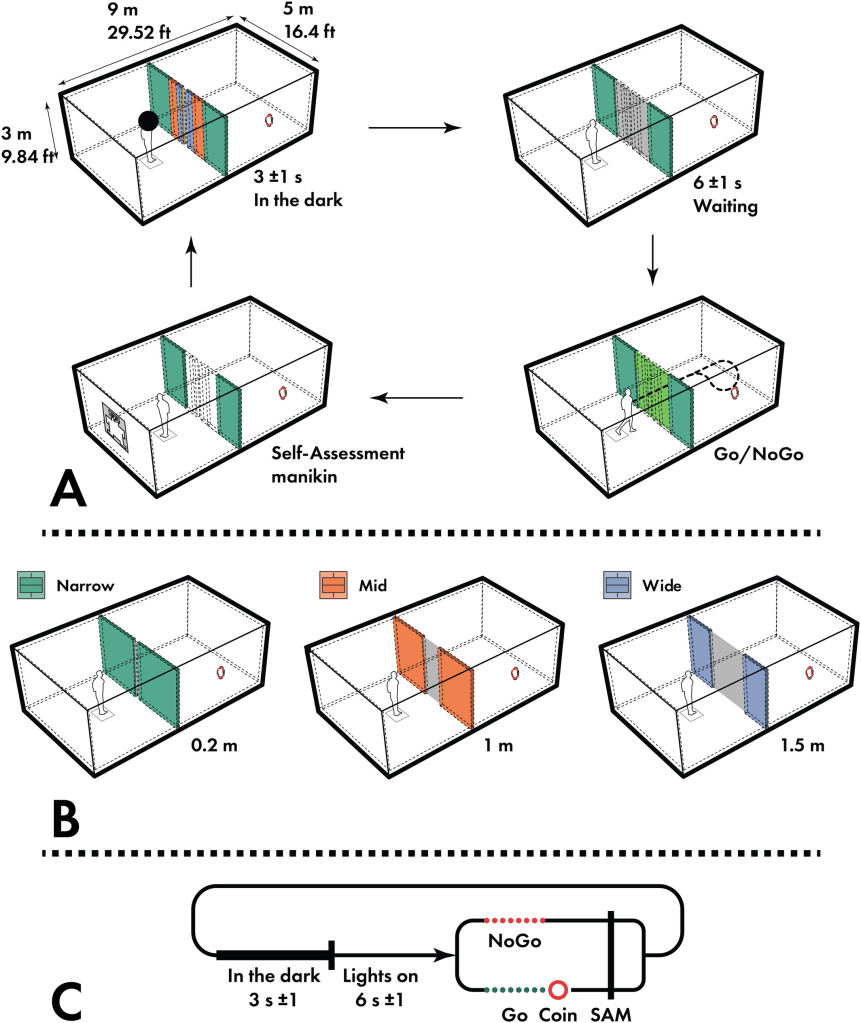
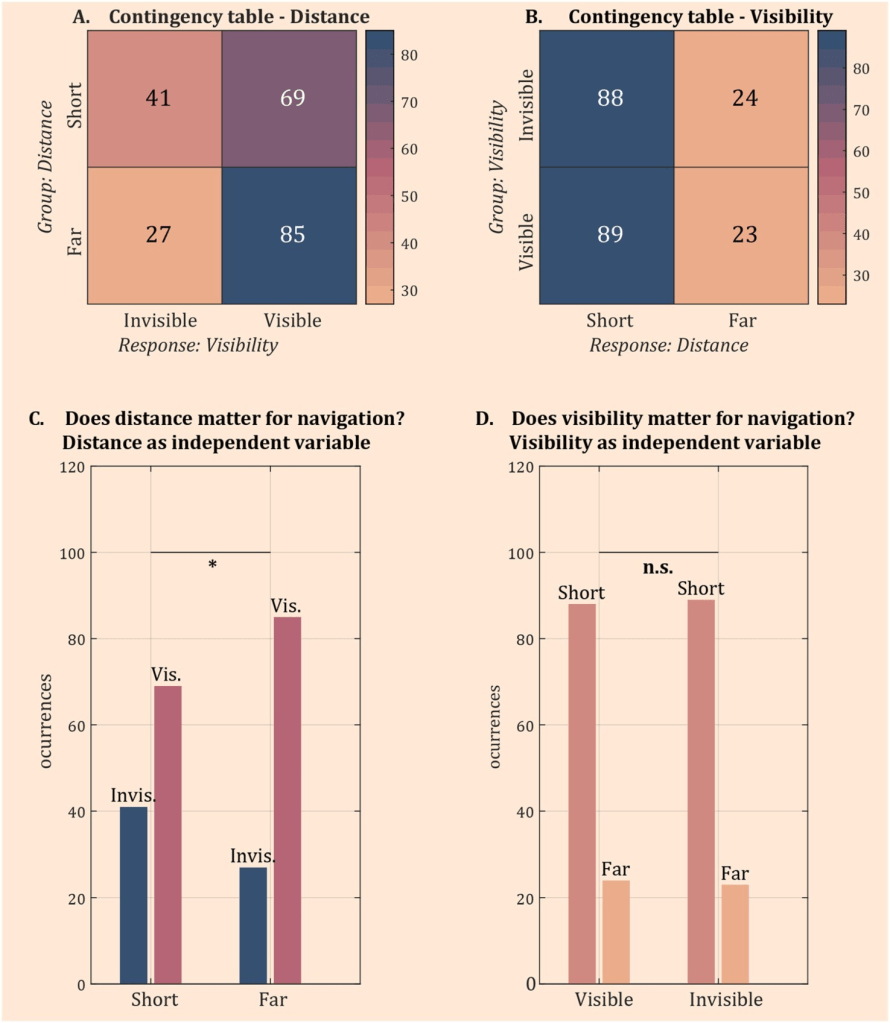
Navigational decisions depend on both cognitive maps and immediate sensory experiences of the environment. However, when both cognitive maps and immediate sensory experiences are uncertain, it is unclear how decisions are made. Here, we question whether visibility of the destination matters more than the distance to that destination as constructed by our cognitive map [Tolman, E. C. 1948. “Cognitive Maps in Rats and men.” Psychological Review 55 (4): 189–208. https://doi.org/10.1037/h0061626%5D. We used Virtual Reality to create an embodied navigation task in a uniform environment, where we varied visibility and distance. Participants located two spheres in the environment and were then instructed to find one of them in a subsequent trial. Participants’ choices and movement were analysed. We find that participants base their navigational decisions on distance rather than visibility, favouring shorter distances over visibility. We find that cognitive maps surpass visual appearance, and embodied interactions are crucial for navigation.
I am the head of the BBAR (Brain, Body, Architecture Research), an internationally oriented research group dedicated to understanding how built environments shape human experience, cognition, and behavior. BBAR focuses on architecture not as a static object, but as a dynamic system that interacts continuously with the human brain and body. The group is today among the most productive and efficient research environments internationally when it comes to generating empirical knowledge about architecture’s effects on cognition, perception, and neural dynamics.
I am a member of The Young Academy, an interdisciplinary academy of outstanding early-career researchers and the younger counterpart to the Royal Society of Science and Letters. The Academy brings together scholars who challenge disciplinary boundaries and contribute actively to society through research, public engagement, and policy dialogue—an ethos that closely aligns with my own view of science as a cultural, ethical, and societal practice rather than a purely technical one.
I was trained as an architect, but I do not believe in disciplines as starting points. Nature does not recognize scientific silos any more than it recognizes national borders or the clock’s segmentation of time. What matters are questions. Methods should follow questions—not the other way around—and they should always be applied cautiously. For this reason, philosophy is central to my work. Understanding the ontological and epistemological assumptions of a method is not optional; it is a prerequisite for using it responsibly. Without this reflection, methods risk producing answers that appear precise while quietly missing the phenomenon they claim to explain.
A core methodological foundation of my research is Mobile Brain/Body Imaging (MoBI), which combines mobile EEG with bodily measures such as movement, physiology, and eye-tracking, often embedded within Virtual Reality environments. Much of my time is therefore spent analyzing brain data in close relation to bodily dynamics and environmental variables. A central methodological effort in my work involves developing new ways of quantifying space from the bodily perspective—for example, by linking eye-tracking, movement trajectories, and VR-based spatial metrics directly to neural dynamics. In this sense, my work is deeply embedded in cognitive and computational neuroscience, while remaining grounded in architectural questions.
A central motivation behind my research is social sustainability, which I consider the most urgent form of sustainability today. Without changes in culture, behavior, and everyday experience, it is difficult to imagine any lasting reduction in our collective footprint on the world. Architecture plays a crucial role here—not by persuading or instructing, but by shaping behavior implicitly, through the structures, rhythms, and affordances of daily life.
My research focuses on how the built environment affects us without our conscious awareness: how it modulates attention, learning performance, movement, walking pace, direction, and even affect—often before we have words for what we are experiencing. I am interested in the automatic responses elicited by architectural environments: how they emerge, whether they can be changed, and how they might be responsibly used in design. Ultimately, my aim is to understand how these processes quietly color our experience of the spaces we inhabit.
The themes that currently guide my work include
(1) rhythms between brain, body, and environment and their mutual entrainment;
(2) time perception and temporal dynamics;
(3) the role of environments in inducing contemplative states;
(4) the thalamus as a key modulator of cognitive and perceptual processes; and
(5) computational phenomenology—an emerging direction that combines phenomenology and enactivism with active inference and Bayesian approaches to cognition.
Across these themes runs a shared question: how architecture participates in the dynamics of mind—not as a backdrop, but as an active constituent of experience.
Nielsen, M. B., Lomholt, C., Yaloz, T., Busk, C. M., Dammann, M., & Djebbara, Z. (2024). Does the visibility of destination matter for navigation?. https://doi.org/10.31234/osf.io/2gyru
Abstract: Landmarks in the urban environment affects navigational performance by way of our memory processes. However, how different kinds of environments affects the encoding process remains poorly understood. This study investigates the impact of landmarks and spatial geometry on memory performance within a virtual urban environment. Through an experimental session utilizing the Hopkins Verbal Learning Test (HVLT) in conjunction with head-mounted virtual reality, participants (N = 35) navigated through a virtual cityscape featuring different environmental variations, which included Landmarks, Space Geometry, and no variations (Normal). Results reveal that participants exposed to landmarks and spatial geometry demonstrated enhanced memory performance compared to those navigating through the normal condition. Specifically, participants exhibited a faster learning rate and improved memory retention in the environments featuring a landmark and a different spatial configuration. These findings underscore the importance of environmental distinctiveness in enhancing memory processes and suggest that both landmarks and different spatial geometry serve as effective mnemonic components in spatial memory tasks. These insights highlight the potential of considering environmental cues to support cognitive functioning and enhance human experience within the built environment.
Landmarks in the urban environment affects navigational performance by way of our memory processes. However, how different kinds of environments affects the encoding process remains poorly understood. This study investigates the impact of landmarks and spatial geometry on memory performance within a virtual urban environment. Through an experimental session utilizing the Hopkins Verbal Learning Test (HVLT) in conjunction with head-mounted virtual reality, participants (N = 35) navigated through a virtual cityscape featuring different environmental variations, which included Landmarks, Space Geometry, and no variations (Normal). Results reveal that participants exposed to landmarks and spatial geometry demonstrated enhanced memory performance compared to those navigating through the normal condition. Specifically, participants exhibited a faster learning rate and improved memory retention in the environments featuring a landmark and a different spatial configuration. These findings underscore the importance of environmental distinctiveness in enhancing memory processes and suggest that both landmarks and different spatial geometry serve as effective mnemonic components in spatial memory tasks. These insights highlight the potential of considering environmental cues to support cognitive functioning and enhance human experience within the built environment.