Wang, S., Djebbara, Z., Sanches de Oliveira, G., & Gramann, K. (2024). Human brain dynamics dissociate early perceptual and late motor-related stages of affordance processing. European Journal of Neuroscience, 60(4), 4639–4660. https://doi.org/10.1111/ejn.16461
Affordances, the opportunities for action offered by the environment to an agent, are vital for meaningful behaviour and exist in every interaction with the environment. There is an ongoing debate in the field about whether the perception of affordances is an automated process. Some studies suggest that affordance perception is an automated process that is independent from the visual context and bodily interaction with the environment, whereas others argue that it is modulated by the visual and motor context in which affordances are perceived. The present paper aims to resolve this debate by examining affordance automaticity from the perspective of sensorimotor time windows. To investigate the impact of different forms of bodily interactions with an environment, that is, the movement context (physical vs. joystick movement), we replicated a previous study on affordance perception in which participants actively moved through differently wide doors in an immersive 3D virtual environment. In the present study, we displayed the same environment on a 2D screen with participants moving through doors of different widths using the keys on a standard keyboard. We compared components of the event-related potential (ERP) from the continuously recorded electroencephalogram (EEG) that were previously reported to be related to affordance perception of architectural transitions (passable and impassable doors). Comparing early sensory and later motor-related ERPs, our study replicated ERPs reflecting early affordance perception but found differences in later motor-related components. These results indicate a shift from automated perception of affordances during early sensorimotor time windows to movement context dependence of affordance perception at later stages, suggesting that affordance perception is a dynamic and flexible process that changes over sensorimotor stages.
Nielsen, M. B., Lomholt, C., Yaloz, T., Busk, C. M., Dammann, M., & Djebbara, Z. (2024). Does the visibility of destination matter for navigation?https://doi.org/10.1080/00038628.2025.2476648
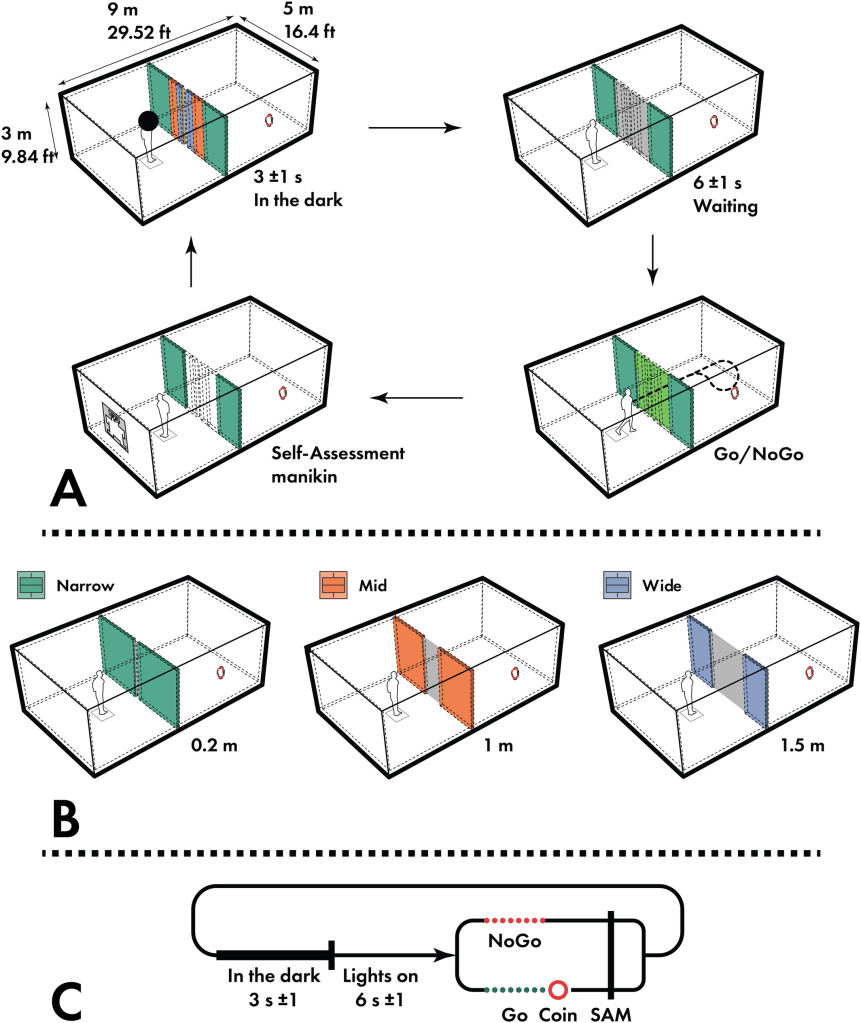
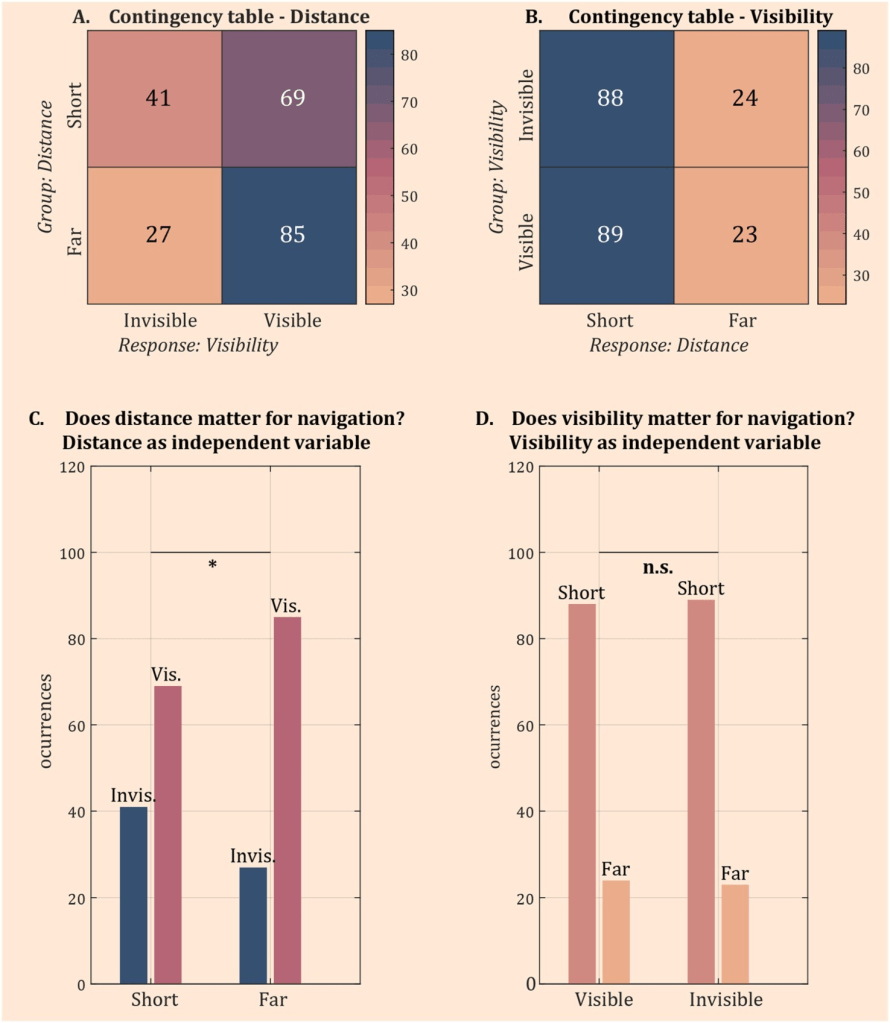
Navigational decisions depend on both cognitive maps and immediate sensory experiences of the environment. However, when both cognitive maps and immediate sensory experiences are uncertain, it is unclear how decisions are made. Here, we question whether visibility of the destination matters more than the distance to that destination as constructed by our cognitive map [Tolman, E. C. 1948. “Cognitive Maps in Rats and men.” Psychological Review 55 (4): 189–208. https://doi.org/10.1037/h0061626%5D. We used Virtual Reality to create an embodied navigation task in a uniform environment, where we varied visibility and distance. Participants located two spheres in the environment and were then instructed to find one of them in a subsequent trial. Participants’ choices and movement were analysed. We find that participants base their navigational decisions on distance rather than visibility, favouring shorter distances over visibility. We find that cognitive maps surpass visual appearance, and embodied interactions are crucial for navigation.
I am the head of the BBAR (Brain, Body, Architecture Research), an internationally oriented research group dedicated to understanding how built environments shape human experience, cognition, and behavior. BBAR focuses on architecture not as a static object, but as a dynamic system that interacts continuously with the human brain and body. The group is today among the most productive and efficient research environments internationally when it comes to generating empirical knowledge about architecture’s effects on cognition, perception, and neural dynamics.
I am a member of The Young Academy, an interdisciplinary academy of outstanding early-career researchers and the younger counterpart to the Royal Society of Science and Letters. The Academy brings together scholars who challenge disciplinary boundaries and contribute actively to society through research, public engagement, and policy dialogue—an ethos that closely aligns with my own view of science as a cultural, ethical, and societal practice rather than a purely technical one.
I was trained as an architect, but I do not believe in disciplines as starting points. Nature does not recognize scientific silos any more than it recognizes national borders or the clock’s segmentation of time. What matters are questions. Methods should follow questions—not the other way around—and they should always be applied cautiously. For this reason, philosophy is central to my work. Understanding the ontological and epistemological assumptions of a method is not optional; it is a prerequisite for using it responsibly. Without this reflection, methods risk producing answers that appear precise while quietly missing the phenomenon they claim to explain.
A core methodological foundation of my research is Mobile Brain/Body Imaging (MoBI), which combines mobile EEG with bodily measures such as movement, physiology, and eye-tracking, often embedded within Virtual Reality environments. Much of my time is therefore spent analyzing brain data in close relation to bodily dynamics and environmental variables. A central methodological effort in my work involves developing new ways of quantifying space from the bodily perspective—for example, by linking eye-tracking, movement trajectories, and VR-based spatial metrics directly to neural dynamics. In this sense, my work is deeply embedded in cognitive and computational neuroscience, while remaining grounded in architectural questions.
A central motivation behind my research is social sustainability, which I consider the most urgent form of sustainability today. Without changes in culture, behavior, and everyday experience, it is difficult to imagine any lasting reduction in our collective footprint on the world. Architecture plays a crucial role here—not by persuading or instructing, but by shaping behavior implicitly, through the structures, rhythms, and affordances of daily life.
My research focuses on how the built environment affects us without our conscious awareness: how it modulates attention, learning performance, movement, walking pace, direction, and even affect—often before we have words for what we are experiencing. I am interested in the automatic responses elicited by architectural environments: how they emerge, whether they can be changed, and how they might be responsibly used in design. Ultimately, my aim is to understand how these processes quietly color our experience of the spaces we inhabit.
The themes that currently guide my work include
(1) rhythms between brain, body, and environment and their mutual entrainment;
(2) time perception and temporal dynamics;
(3) the role of environments in inducing contemplative states;
(4) the thalamus as a key modulator of cognitive and perceptual processes; and
(5) computational phenomenology—an emerging direction that combines phenomenology and enactivism with active inference and Bayesian approaches to cognition.
Across these themes runs a shared question: how architecture participates in the dynamics of mind—not as a backdrop, but as an active constituent of experience.
Nielsen, M. B., Lomholt, C., Yaloz, T., Busk, C. M., Dammann, M., & Djebbara, Z. (2024). Does the visibility of destination matter for navigation?. https://doi.org/10.31234/osf.io/2gyru
Abstract: Landmarks in the urban environment affects navigational performance by way of our memory processes. However, how different kinds of environments affects the encoding process remains poorly understood. This study investigates the impact of landmarks and spatial geometry on memory performance within a virtual urban environment. Through an experimental session utilizing the Hopkins Verbal Learning Test (HVLT) in conjunction with head-mounted virtual reality, participants (N = 35) navigated through a virtual cityscape featuring different environmental variations, which included Landmarks, Space Geometry, and no variations (Normal). Results reveal that participants exposed to landmarks and spatial geometry demonstrated enhanced memory performance compared to those navigating through the normal condition. Specifically, participants exhibited a faster learning rate and improved memory retention in the environments featuring a landmark and a different spatial configuration. These findings underscore the importance of environmental distinctiveness in enhancing memory processes and suggest that both landmarks and different spatial geometry serve as effective mnemonic components in spatial memory tasks. These insights highlight the potential of considering environmental cues to support cognitive functioning and enhance human experience within the built environment.
Landmarks in the urban environment affects navigational performance by way of our memory processes. However, how different kinds of environments affects the encoding process remains poorly understood. This study investigates the impact of landmarks and spatial geometry on memory performance within a virtual urban environment. Through an experimental session utilizing the Hopkins Verbal Learning Test (HVLT) in conjunction with head-mounted virtual reality, participants (N = 35) navigated through a virtual cityscape featuring different environmental variations, which included Landmarks, Space Geometry, and no variations (Normal). Results reveal that participants exposed to landmarks and spatial geometry demonstrated enhanced memory performance compared to those navigating through the normal condition. Specifically, participants exhibited a faster learning rate and improved memory retention in the environments featuring a landmark and a different spatial configuration. These findings underscore the importance of environmental distinctiveness in enhancing memory processes and suggest that both landmarks and different spatial geometry serve as effective mnemonic components in spatial memory tasks. These insights highlight the potential of considering environmental cues to support cognitive functioning and enhance human experience within the built environment.
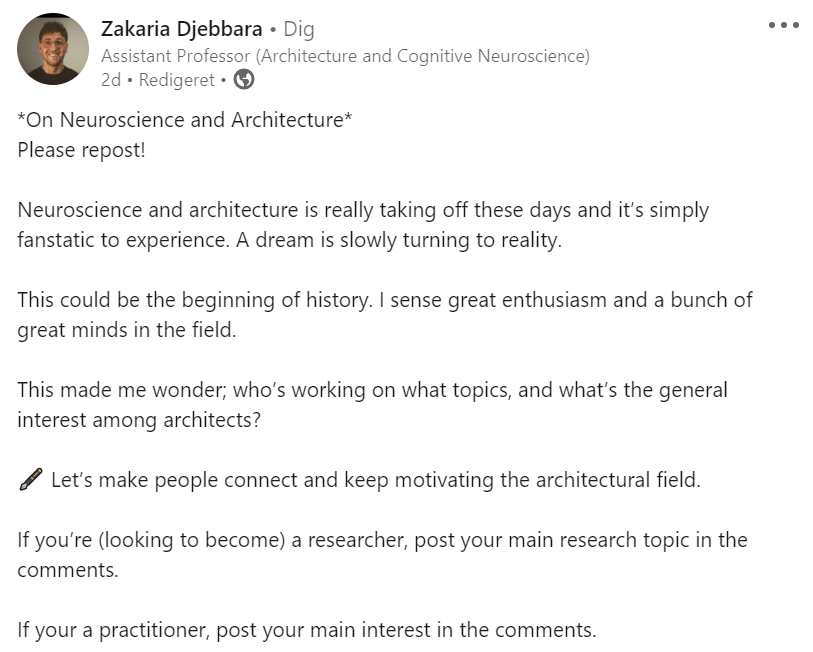
Knowledge has long been primarily shared through lectures, books, and articles. Today, knowledge is shared and gathered largely through social media. This is surely not true for fields. However, from one of my LinkedIn posts, it’s clear that the interdisciplinary field of neuroscience and architecture has a vibrant social media profile. Over 2 days, the post gathered >150 comments expressing either interest or current work from researchers, advisors, and scientists! There were numerous young bright minds aspiring to become researchers too.
These insights promise a bright future for our field.
Judging from the posts, the majority serve to translate the science to architects, suggesting ways in which the conclusions can serve design goals. This is an important task for all interdisciplinary fields: communicating back to the constitutive fields. Unfortunately, researchers affiliated with a university are a minority. Nothing absolute can be concluded from the post—however, there seems to be a greater interest in the field from the industrial side than the academic side can provide. This situation is typically resolved by increasing the number of Ph.D. students and collaborations between universities and industrial partners. This will ensure a high level of scientific rigor and direct access to results for design implementations.
This is a golden opportunity for both architectural studios and grant holders to invest in a field that is highly motivated to produce practical results.
In other words, there’s a strong and interested market, motivated researchers and practitioners, and huge areas of untouched scientific territory for everyone to learn from. The possibilities are enormous, but they’re still waiting to be unleashed.
Det ligger i arkitektens natur at gå undersøgende til værks. Men uden en omfattende forståelse af de vidtrækkende implikationer af deres design risikerer arkitekter at bidrage til nedsat mentalt velvære. Det er afgørende for fremtiden at anerkende manglen på evidens for at arkitekter kan skabe rum, der bevarer planeten og fremmer mental helbred, skriver Zakaria Djebbara og Anders Barslund i dette debatindlæg.
Translation:
It is in the architect’s nature to investigate. But without a comprehensive understanding of the far-reaching implications of their designs, architects risk contributing to diminished mental well-being. It is crucial for the future to recognize the lack of evidence to enable architects in creating spaces that preserve the planet and promote mental health, write Zakaria Djebbara and Anders Barslund in this debate post.
Djebbara, Z., King, J., Ebadi, A., Nakamura, Y., & Bermudez, J. (2023). Contemplative neuroaesthetics and architecture: A sensorimotor exploration. Frontiers of Architectural Research. https://doi.org/https://doi.org/10.1016/j.foar.2023.10.005
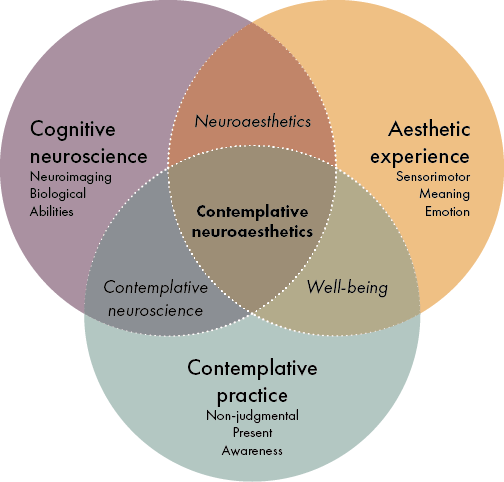
Abstract. This paper takes initial steps towards developing a theoretical framework of contemplative neuroaesthetics through sensorimotor dynamics. We first argue that this new area has been largely omitted from the contemporary research agenda in neuroaesthetics and thus remains a domain of untapped potential. We seek to define this domain to foster a clear and focused investigation of the capacity of the arts and architecture to induce phenomenological states of a contemplative kind. By proposing a sensorimotor account of the experience of architecture, we operationalize how being attuned to architecture can lead to contemplative states. In contrasting the externally-induced methods with internally-induced methods for eliciting a contemplative state of mind, we argue that architecture may spontaneously and effortlessly lead to such states as certain built features naturally resonate with our sensorimotor system. We suggest that becoming sensible of the resonance and attunement process between internal and external states is what creates an occasion for an externally-induced contemplative state. Finally, we review neuroscientific studies of architecture, elaborate on the brain regions involved in such aesthetic contemplative responses, provide architectural examples, and point at the contributions that this new area of inquiry may have in fields such as the evidence-based design movement in architecture.
Abstract. Rhythms exist both in the embodied brain and the built environment. Becoming attuned to the rhythms of the environment, such as repetitive columns, can greatly affect perception. Here, we explore how the built environment affects human cognition and behavior through the concept of natural attunement, often resulting from the coordination of a person’s sensory and motor systems with the rhythmic elements of the environment. We argue that the built environment should not be reduced to mere states, representations, and single variables but instead be considered a bundle of highly related continuous signals with which we can resonate. Resonance and entrainment are dynamic processes observed when intrinsic frequencies of the oscillatory brain are influenced by the oscillations of an external signal. This allows visual rhythmic stimulations of the environment to affect the brain and body through neural entrainment, cross-frequency coupling, and phase resetting. We review how real-world architectural settings can affect neural dynamics, cognitive processes, and behavior in people, suggesting the crucial role of everyday rhythms in the brain-body-environment relationship.
🚨NEW PAPER🚨 "On natural attunement: Shared rhythms between the brain and the environment"
Our new (open access) paper, in collab with the fantastic Efrosini Charalambous, reviews the rhythmic relationship between brains and buildings.
In this new Commentary paper, I share my thoughts on Maselli et al.’s paper “Beyond simple laboratory studies” and suggest that we need more (and richer) ways to quantify the relationship between organism and environment.
Cognition and behavior are the adapted results of environmental perturbations, which we today are (almost) in full control of by way of architects and designers. Environmental features thus hold great importance in understanding behavior and quantifying these features could thus be the next milestone for sophisticated models.


 Zak's Blog