Huynh, D. C., Hussein, A. K., Behzadi, F., Kalantarifard, A., Fich, L. B., & Djebbara, Z. (2026). Moving beyond environmental categories in environmental psychology. Journal of Environmental Psychology, 111, 103016. https://doi.org/10.1016/j.jenvp.2026.103016
Full paper can be found here.
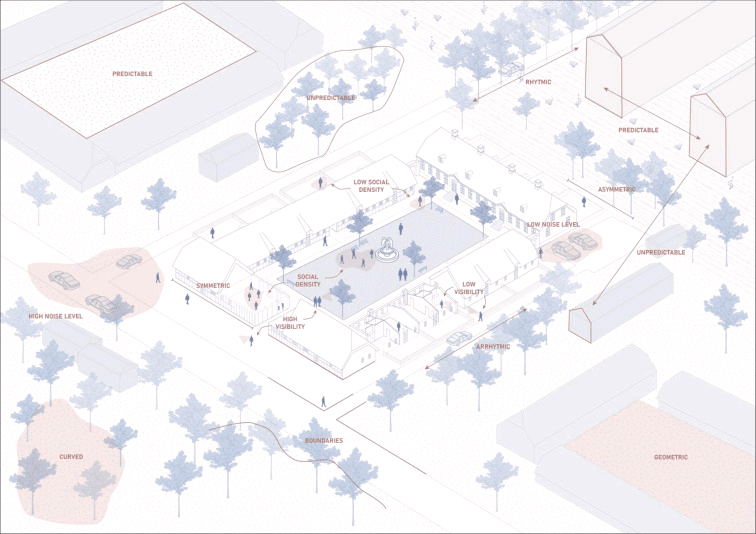
A growing body of research in environmental psychology demonstrates that environments influence cognition, affect, and mental health. However, environmental effects are still predominantly interpreted through broad categorical distinctions such as urban/rural and nature/built. While productive for identifying differences between settings, these categories encompass highly heterogeneous environments with fundamentally different perceptual, spatial, social, and structural properties. As a result, findings across the literature remain difficult to reconcile, and the mechanisms linking environmental exposure to psychological outcomes often remain underspecified. In this review, we argue that environmental influences on cognition and mental health are better understood in terms of feature-specific interactions rather than categorical environment types. Drawing on evidence from environmental psychology and cognitive neuroscience, we show that the psychological effects of environments cut across conventional distinctions and vary substantially both within and between settings. We synthesize findings demonstrating how category-based approaches obscure mechanistic understanding and limit theoretical integration, particularly across disciplines. To address these limitations, we propose a feature-based approach in which environments are conceptualized as multidimensional profiles and organized into a minimal set of feature families aligned with temporal scales of processing (sensory, perceptual, and semantic process). This scaffold links environmental specification to mechanistic hypotheses and measurable variables, providing a principled basis for interpreting heterogeneity in cognitive and mental health findings and for advancing cumulative theory, method, and application in environmental psychology.
 Zak's Blog