Rad, P. N., Behzadi, F., Kalantarifard, A., Nazemi, N., & Djebbara, Z. (2026). Indoor environmental quality and the brain: A systematic review of physiological and neural evidence. Building and Environment, 294, 114405.
Link to full paper.
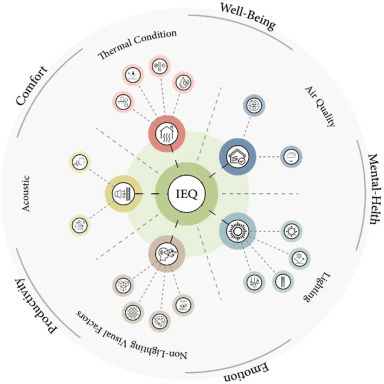
Indoor environmental quality (IEQ) encompasses the conditions inside a building and their effects in shaping occupants’ cognitive functions. As cognitive performance is fundamentally rooted in neural and physiological processes, any influence of IEQ on humans necessarily begins with its impact on the brain and body, through neural and physiological responses. Previous studies on IEQ have primarily focused on outcomes such as comfort, productivity, etc., whereas the physiological and neural pathways underlying these effects on the human body and brain remain insufficiently explored. This present review synthesizes empirical studies on how different IEQ components, including thermal environment, air quality, acoustics, lighting, and non-light visual factors, affect human physiological and brain-related responses across four key themes: comfort, health and well-being, productivity, and emotion. A detailed manual review was conducted on 32 empirical studies, followed by a co-occurrence analysis of keywords and abstracts from 6,006 publications to map the relationships between IEQ and brain or body responses. Overall, the findings suggest that IEQ has a significant influence on physiological states and brain activity, with distinct effects depending on the specific factor examined. Notably, the majority reported associations between IEQ variables, particularly temperature, and non-light visual factors with measurable neural and physiological changes. These insights can guide the design of healthier indoor environments that promote productivity, comfort, and well-being. Future studies should aim to establish standardized methodologies and explore long-term effects in real-world contexts.
 Zak's Blog