Djebbara, Z., Huynh, D. C., Koselevs, A., Chen, Y., Fich, L. B., & Gramann, K. (2025). Turning corners in built environments shifts spatial attention costs. NeuroImage, 121549.
Link to full paper.
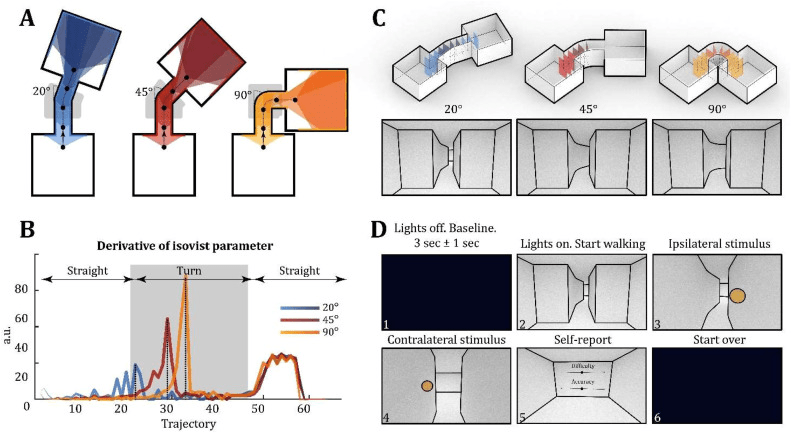
Human attention is typically studied under static laboratory conditions, yet everyday cognition unfolds during active interactions with the built environment. Here we show that architectural features such as corners not only cue spatial attention but can shift canonical attention cueing costs. Using Mobile Brain/Body Imaging in a naturalistic Virtual Reality (VR), participants physically navigated corridors with varying turning angles while responding to visual targets appearing either congruent or incongruent with the turn direction. We show a shift in attention costs of the classic congruency effect with faster and more accurate responses to incongruent stimuli, emerging at ∼15° for accuracy and ∼30° for response times. This suggests that embodied movements engage attentional dynamics distinct from traditional desktop experiments. We found that the early (N1) and late (P3) attention-related electrophysiological responses were modulated by environmental features and motor demands. N1 amplitudes decreased and P3 responses were attenuated for sharper turns, particularly in congruent conditions, reflecting the redistribution of attentional resources under increased visuomotor demands. We propose that congruent stimuli, displayed against a backdrop of novel visual information, increases cognitive load and slows early visual processing that affect behavioral responses. Incongruent stimuli are, however, displayed against a backdrop of predictable visual information allowing faster target processing. These findings demonstrate that naturalistic locomotion can invert classical attention patterns, highlighting how architectural geometry shapes perception, cognition, and action.
 Zak's Blog