Kalantarifard, A., Faizi, M., Ekhlassi, A., Behzadi, F., & Djebbara, Z. (2025). Color and Pattern of Material Reflect Thermal Perception in Early Brain Dynamics (SSRN Scholarly Paper No. 5332545). Social Science Research Network.
Link to paper here.
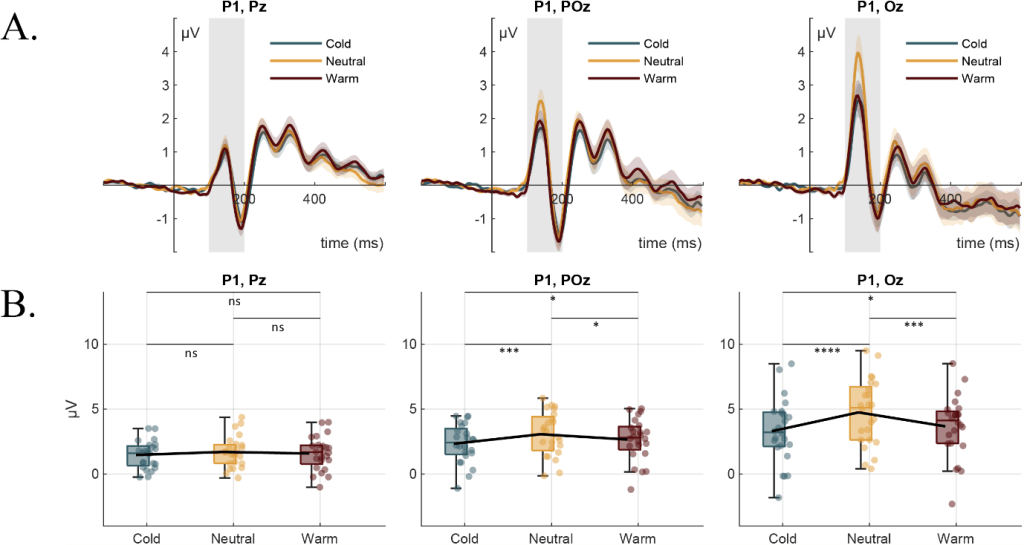
Thermal perception within indoor environments is shaped by the integration of multiple sensory inputs, with visual stimuli playing a critical role. While existing work has demonstrated that room color can influence thermal perception under directed attention, it remains unknown how this effect manifests when the colored environment is perceived passively during an ongoing cognitive task. In this study, we investigated the combined effect of wooden materials’ visual characteristics—namely, color and pattern—on evoked brain responses. A combination of three wooden colors (Warm, Neutral, and Cold) and three pattern complexities (No-, Simple-, and Complex-Pattern) formed nine different Virtual Reality (VR) environments. Subjective thermal evaluations and ongoing neural responses were recorded via electroencephalography (EEG) during an Oddball paradigm task (N = 24). Subjective reports demonstrate that wood colors and patterns significantly affected thermal perception. We extracted the P1 and P2 components over the parieto-occipital area and analyzed them using a mixed linear effects regression, demonstrating the impact of wood color on P1 and pattern complexity on P2. Our study indicates that early attentional processes are significantly influenced by color, with warmer hues leading to an increase in perceived temperature. Although the effect of pattern on thermal perception appears to be relatively minor, denser visual patterns were still associated with a further rise in perceived warmth. Future research could compare the visual impact of various materials on thermal perception.
 Zak's Blog