Beatini, V., Pantilimonescu, F., Djebbara, Z., & Drișcu, M.-C. (2024). Adaptive facades for emotionally enriching indoor environments. Journal of Building Engineering, 98, 111472. https://doi.org/10.1016/j.jobe.2024.111472
Link to full paper here.
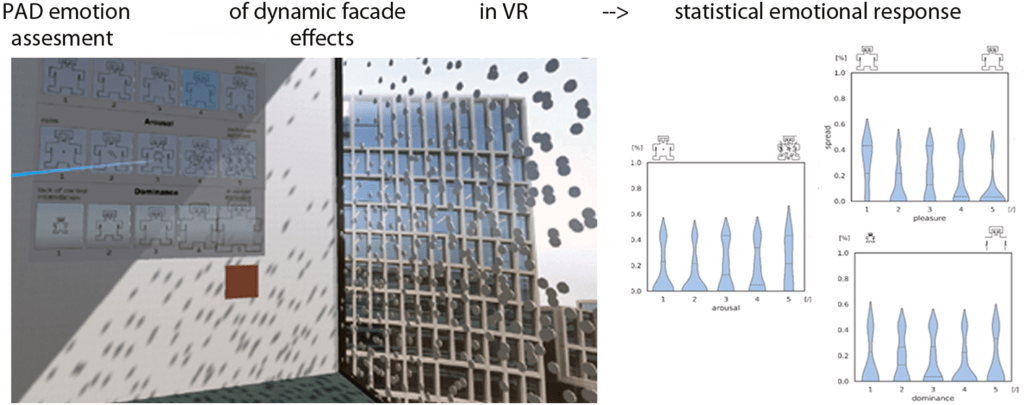
Buildings are increasingly required to have a restorative effect as people spend a significant portion of their time indoors, inducing them stress. In this regard, the research investigates the emotional impact of adaptive façades, focusing on the correlation between shadow patterns and emotions elicited. Using a combination of controlled Virtual Reality experiments and statistical comparisons, the study explores how different dynamic effects, abstracted from the specificity of the design, influence emotional responses, the latter based on the PAD (Pleasure-Arousal-Dominance) affection model. Empirical data supports the hypothesis that dynamic architecture can significantly enhance the emotional experience of indoor environments, highlighting the potential for adaptive façade designs to enhance indoor environments. Future studies are recommended to validate these findings in real-world settings and explore the integration of additional sensory dynamics, also considering demographic factors. This study marks a first step in exploring the possibility to inform design practices by linking abstract design features and emotional impacts.
 Zak's Blog