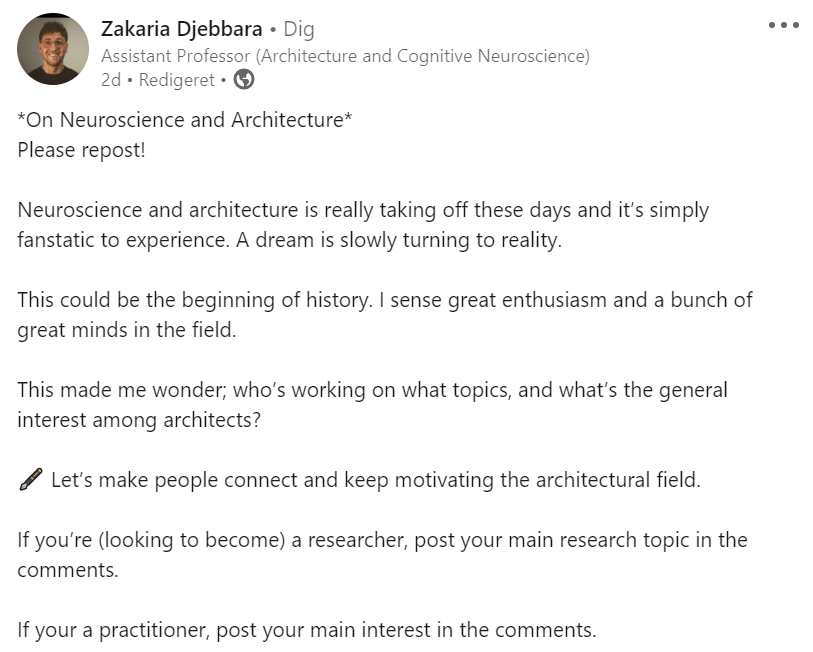
Knowledge has long been primarily shared through lectures, books, and articles. Today, knowledge is shared and gathered largely through social media. This is surely not true for fields. However, from one of my LinkedIn posts, it’s clear that the interdisciplinary field of neuroscience and architecture has a vibrant social media profile. Over 2 days, the post gathered >150 comments expressing either interest or current work from researchers, advisors, and scientists! There were numerous young bright minds aspiring to become researchers too.
These insights promise a bright future for our field.
Judging from the posts, the majority serve to translate the science to architects, suggesting ways in which the conclusions can serve design goals. This is an important task for all interdisciplinary fields: communicating back to the constitutive fields. Unfortunately, researchers affiliated with a university are a minority. Nothing absolute can be concluded from the post—however, there seems to be a greater interest in the field from the industrial side than the academic side can provide. This situation is typically resolved by increasing the number of Ph.D. students and collaborations between universities and industrial partners. This will ensure a high level of scientific rigor and direct access to results for design implementations.
This is a golden opportunity for both architectural studios and grant holders to invest in a field that is highly motivated to produce practical results.
In other words, there’s a strong and interested market, motivated researchers and practitioners, and huge areas of untouched scientific territory for everyone to learn from. The possibilities are enormous, but they’re still waiting to be unleashed.
Find the original post here:
 Zak's Blog